
Your shopping cart is empty!
Shopping Cart
0 item(s) - FreeCustomization and Conversion for: Ctrader, MetaTrader(MT4, MT5), Thinkorswim, NinjaTrader, MultiCharts, Tradingview, Prorealtime, SierraChart, etc.
License renew price will be 20% off for the 2nd year and after.
Every Purchase Comes with a Coupon.
Share Your Experience. Help Other Traders Learn. Get Rewarded.
Share Your Experience. Help Other Traders Learn. Get Rewarded.
Featured




Trend Pullback Reversal TPR indicator for NinjaTrader 8
 (
(One Indicator. Three Insights. Trend | Pullback | Reversal.
A professional trend analysis indicator that helps traders distinguish between trend continuation, pullbacks, and potential reversals while filtering out much of the market noise. Whether you trade intraday index futures, forex, or digital assets, TPR provides a clean, institutional-grade visual layout to keep you on the right side of the primary trend.
New to TPR? Get started with our Introduction to the Trend Pullback Reversal (TPR) Indicator and discover how it transforms your chart analysis.
Why Choose TPR?
TPR = Indicator + Method + Community + Ecosystem
TPR is more than a technical indicator. It is a complete trading methodology designed to help traders identify Trend, Pullback, and Reversal conditions across different markets, timeframes, and chart types within a unified framework.
Combined with the ChartZone.net community, it creates a continuous cycle of use, feedback, learning, and evolution. **TPR provides the analytical framework. ChartZone provides the environment where that knowledge can be shared, tested, and expanded.**Core System Architecture & Features
1. Dynamic Trend Tracking Engine
TPR plots an adaptive structural boundary directly on the price chart, functioning as dynamic support and resistance.
- Macro Trend Identification: Highlights macro buying dominance and establishes a trailing support structure.
- Institutional Distribution Detection: Isolates distribution zones and provides dynamic resistance boundaries.
- Adaptive Boundary: The main TPR line acts as dynamic support in uptrends and resistance in downtrends.
- Visual Confirmation: Real-time color changes provide clear visual confirmation of trend shifts.
Deep Dive Guides:
- See how settings affect behavior in The impact of different Factor and Period inputs on the TPR indicator.
2. Volatility Envelope & Outlier Detection
An optional expanded trailing zone provides a quantified statistical band for volatility expansion.
- Extreme Volatility Identification: When trend lines breach this dynamic boundary, the system identifies overextended market states.
- Mean Reversion & Shift Preparation: Warns of impending structural exhaustion before a sharp pullback or primary trend reversal occurs.
Deep Dive Guides:
- Understand the structural differences in Trailing Band vs. PullBack Channel (also available as PullBack Channel vs. Trailing Band).
- Master volatility-based strategy in How Trailing Band Width Changes the Behavior of TPR: Building Dynamic Profit Targets, Trailing Stops, and Support & Resistance.
3. Early Warning Structural Reversal Signals
- Reversal Signal Dots: High-precision visual markers (orange/cyan) identify potential structural points where a change in direction may be developing.
- Noise Reduction Filtering: Signals are generated only when price action interacts with dynamic volatility thresholds, eliminating false chop during low-liquidity regimes.
4. Real-Time Quantitative Trend Statistics (Trend Duration Table)
TPR includes an embedded real-time statistical engine that tracks trend duration directly on your chart:
- Historical Extremes: Monitors maximum bar persistence for both uptrends and downtrends across the current chart session.
- Statistical Averages: Calculates mean trend length to establish a baseline for expected market moves.
- Exhaustion Metrics: Compares current active trend duration against historical averages, alerting traders when a trend is mathematically overextended and prone to a mean-reversion pullback.
- Learn the core mechanics in Trend analysis with Trend Pullback Reversal TPR indicator.
Strategic Trading Approaches
Multi-Parameter / Multi-Timeframe Approach
Apply two instances of TPR on the same chart:
- Main chart: Shorter-term settings (more sensitive) for precise entries and exits.
- Sub-chart: Longer-term settings for overall trend direction.
Crucial Rule: Strongest signals occur when both short-term and long-term TPR lines are the same color (both green or both red). When they diverge, treat short-term signals with caution—they often represent temporary counter-moves or traps within the dominant trend.
Strategic Application Guides:
- Eliminate Lag: Read our architectural whitepaper on Why TPR Doesn’t Use MTF (No Structural Lag) to understand how we resolve multi-timeframe insights without traditional indicators’ lagging side-effects.
- See it in action: Check out An example of Multi-Timeframe Technical Analysis by TPR.
- Synthesize perspectives with Multi-Parameter TPR Analysis: Understanding Trend Development Through Multiple Perspectives.
- Maximize trading results using How to Use the TPR Indicator More Effectively.
Pullback Channel Customization & Optimization
Enhance your trend entry precision with fine-tuned Pullback Channel behaviors:
- Pullback Setup Guide: How to Use the TPR PullBack Channel Feature.
- Optimization Framework: Optimizing the PullBack Channel Factor: How It Should Change with TPR Trend Settings.
Works Across Markets & Platforms
TPR is highly versatile and fits directly into your existing setup:
- Supported Assets: ✓ Stocks ✓ Futures ✓ Forex ✓ Crypto ✓ Indices ✓ CFDs
- Compatible Charts: Works on all timeframes and most standard price-based chart types (including Candlestick, OHLC Bar, Line Break, Heikin Ashi, Renko, and Range Bars).
Resource Center & Support
Have questions? Check the FAQ tab or contact us—we’re happy to help.
Note: Unless otherwise specified, TPR functions identically across all platforms, and there should be no material difference in the plots and drawing objects shown in the screenshots. If screenshots for your specific platform are limited, you may refer to those from any platform, as they are essentially identical.
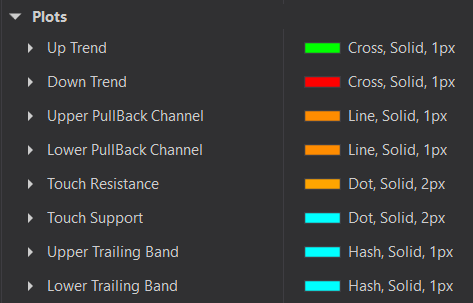
Parameters:
TPR Factor
Controls the sensitivity of the TPR trend lines.
A higher value places the trend bands farther away from price, resulting in fewer but stronger signals. A lower value makes the indicator more responsive but may increase noise.
TPR Period
Defines the number of historical bars used to calculate the underlying trend.
Smaller values make the indicator react faster to price changes, while larger values produce smoother and more stable trend detection.
Potential Rebound Signal
Enables early signals that indicate a possible price rebound within an existing trend.
These signals are typically more aggressive and can help anticipate reversals before full confirmation.
Enable PullBack Channel
Turns on the pullback channel, which highlights retracement zones within a trend.
This helps identify potential entry areas during temporary counter-trend movements.
PullBack Channel Factor
Adjusts the width of the pullback channel.
Higher values create a wider channel (looser pullback zones), while lower values tighten the channel for more precise entries.
Enable Trailing Band
Activates a trailing band that follows price action.
This feature is commonly used for dynamic stop-loss placement or trend-following exits.
Trailing Band Width in Ticks
Specifies the distance between price and the trailing band, measured in ticks.
Larger values provide more room for price fluctuations, while smaller values keep the band tighter for more aggressive risk management.
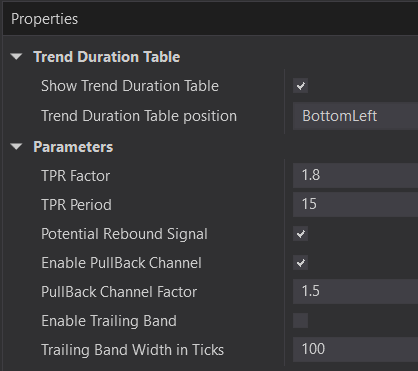
The new feature of Trend Duration Table will show the following six data on chart.
- Longest Up-Trend: the max number of bars stay on up trend based on the current chart.
- Avg Up-Trend: the average number of bars stay on up trend based on the current chart.
- Latest Up-Trend: the number of bars stay on previous or current up trend.
- Longest Down-Trend: the max number of bars stay on down trend based on the current chart.
- Avg Down-Trend: the average number of bars stay on down trend based on the current chart.
- Latest Down-Trend: the number of bars stay on previous or current down trend.
For more info about the Trend Duration Table please visit: Trend analysis with Trend Pullback Reversal TPR indicator


This is a video of how TPR indicator on NT8 performs in a relatively long-term downtrend of Forex AUDUSD 5 min chart.
You may think it looks like supertrend or braintrend, right?
Actually, most trend indicators have a similar plot, the differences are where and when they give signals.
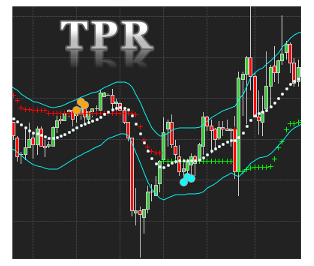
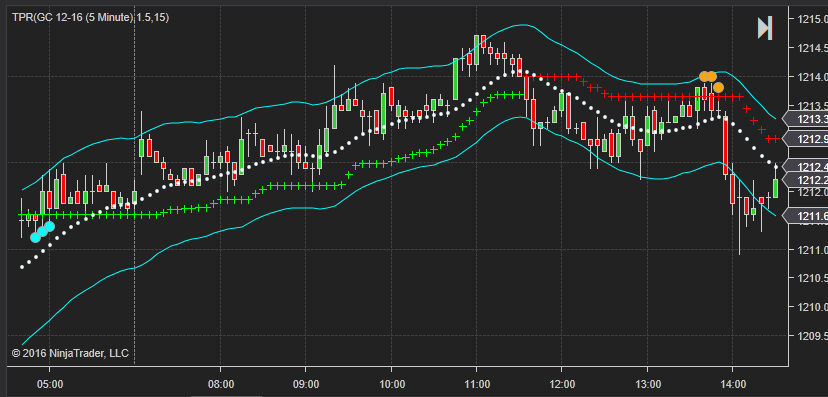
Unlike other trend indicators, TPR will focus on the main trend and filter out most minor price movements. The green cross-line represents an uptrend, the red cross-line represents a downtrend, and the blue dots are signals for possible reversals.
The additional band and center line may look like bollinger band, but the TPR band algorithm is completely different from bollingerband. There is no standard deviation in TPR band calculation.
The following image is a comparison of TPR and BOLL.
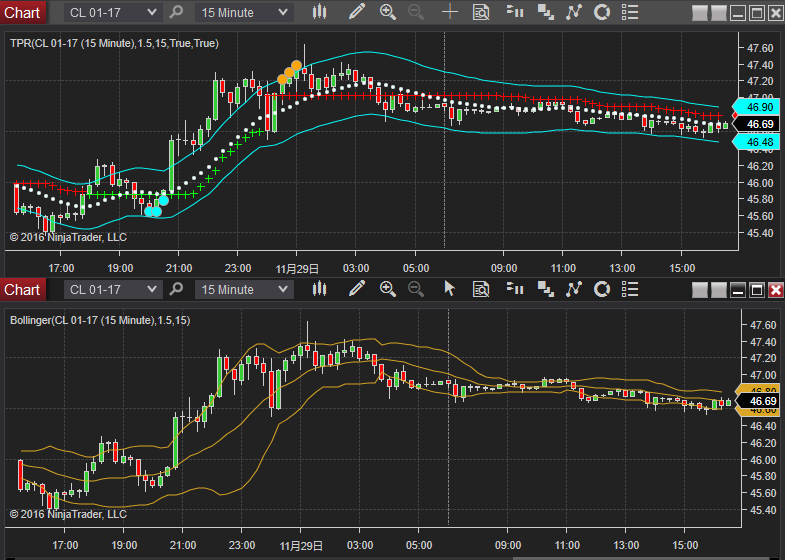
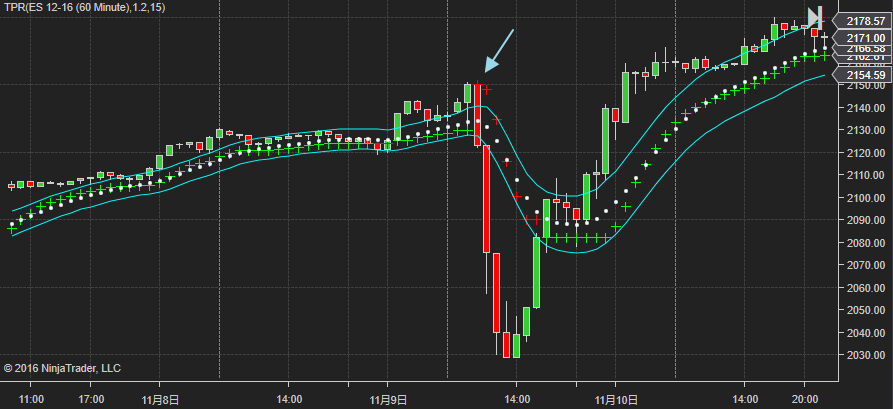
The TPR band gives a possible range of the TPR movement, if TPR is outside the band for many bars or far away from the band, it could be a sign of trend reversal.
The chart below is an example of TPR outside of band.
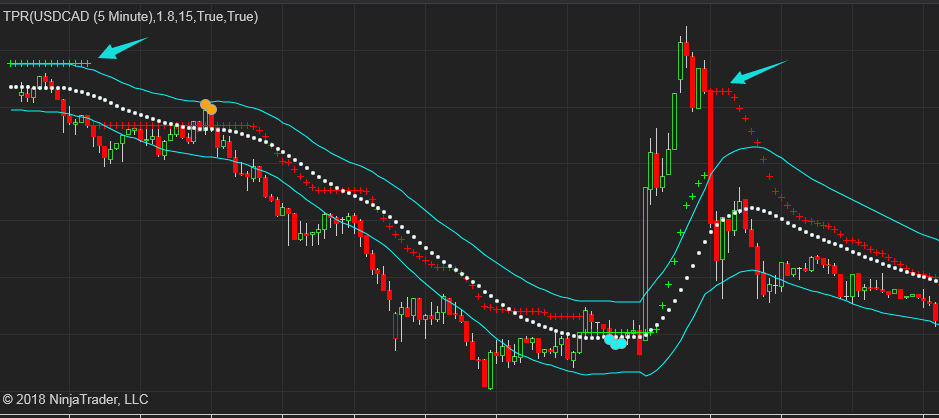
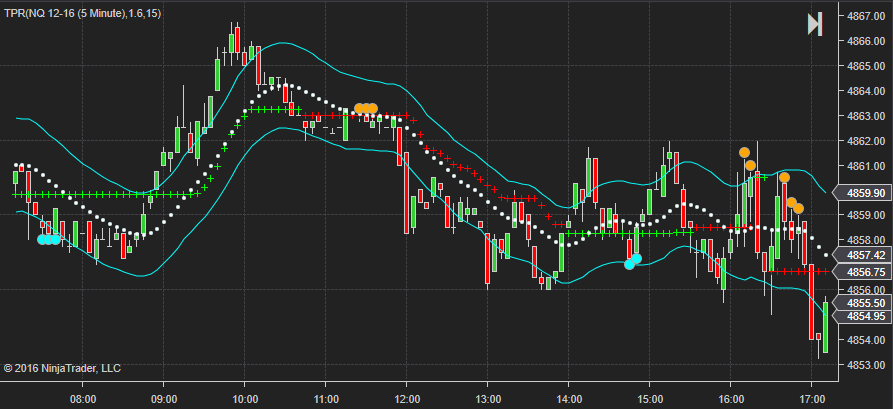
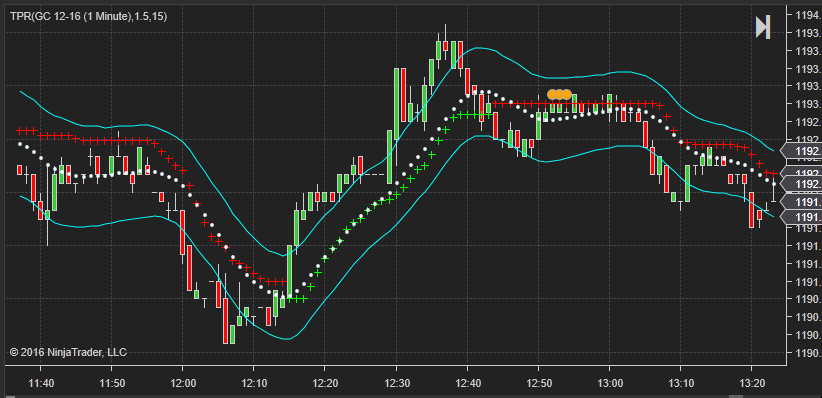
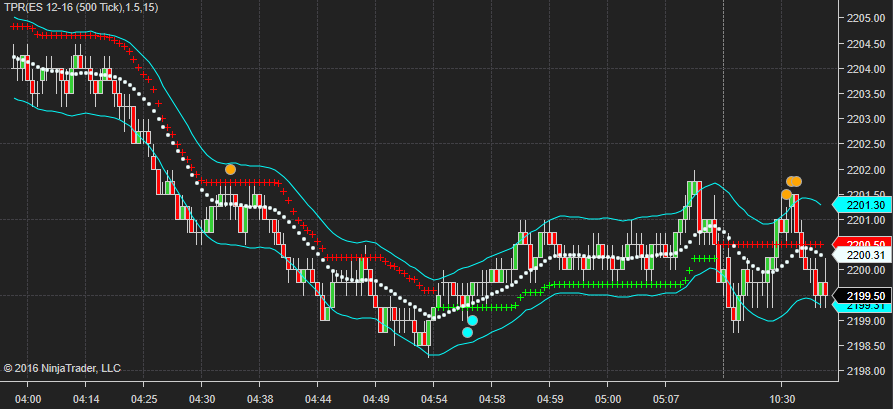
You can see how TPR reacts to price movement from the following images.
The orange and cyan dots give possible reversal signals.
|
|




The following image shows where you can find the TPR column in Market Analyzer.
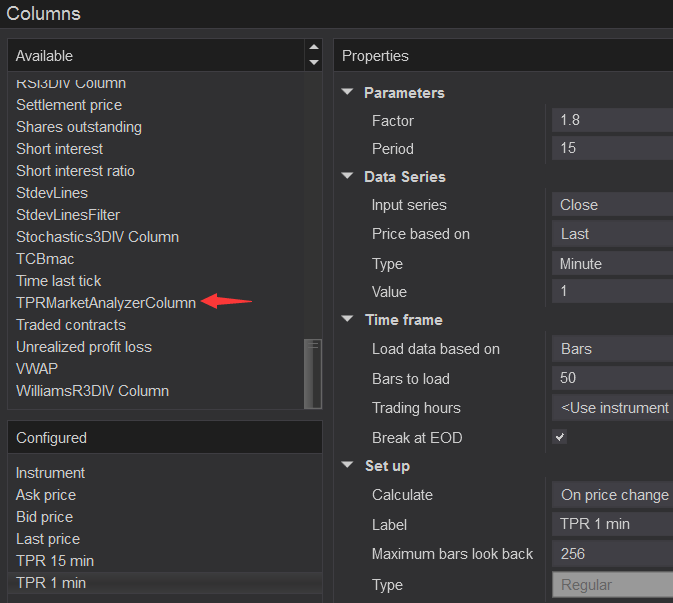
It will display "Uptrend start" if the current bar is the first bar that turns into uptrend.
It will display "Downtrend start" if the current bar is the first bar that turns into downtrend.
Otherwise, it will display "Uptrend" or "downtrend" in corresponding indicator status.

If you are familiar with the Supertrend indicator, you may think the TPR is almost the same as Supertrend. In this case, you should read the following content.
If only check the line plot from both Supertrend and TPR, it's easier to notice that TPR may change trend earlier than supertrend, as shown in the charts below, but that's not the main difference between them.
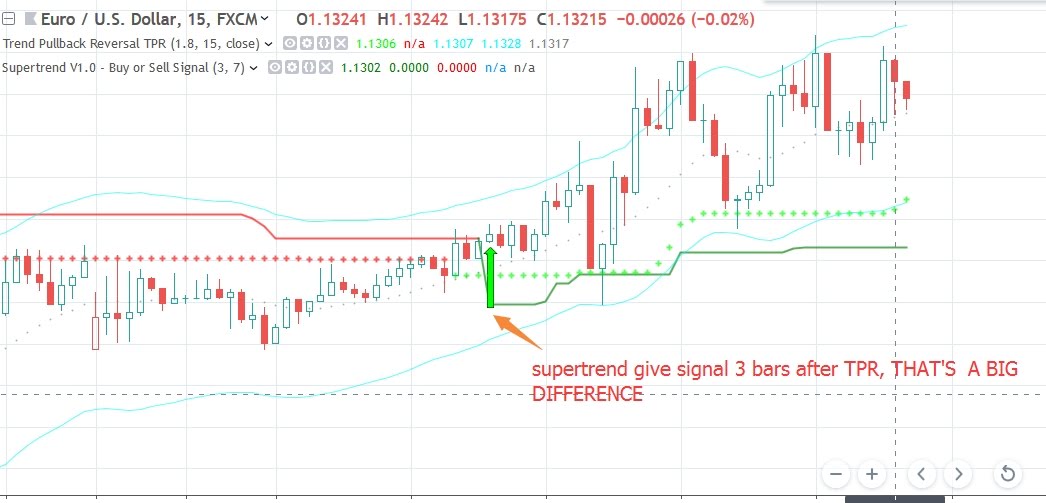
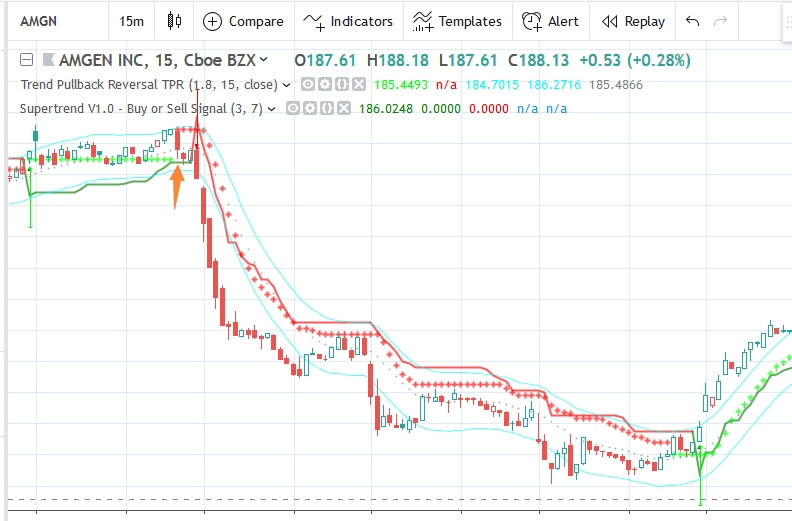
The most important difference between TPR and supertrend is that TPR can be used as a support and resistance indicator as well, not just a trend indicator.
The following 2 charts have both TPR and supertrend. The solid line is from supertrend, the cross line is TPR.
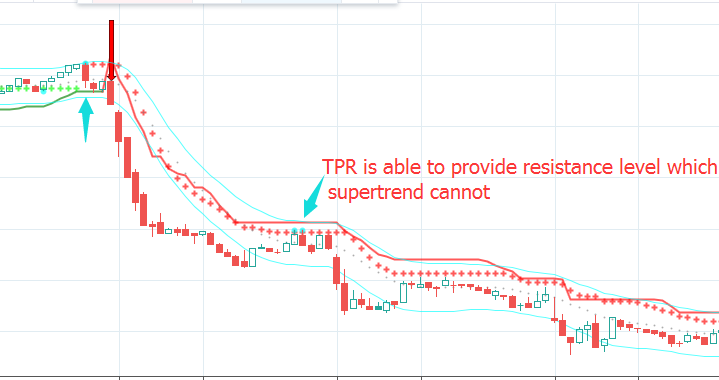
As you can see, the line from TPR provides a very good support and resistance level, but supertrend is far away from the price bar which cannot be used as support and resistance level at all.

In short, if you only need a trend indicator, both TPR and Supertrend will do the job.
But if you also want it to provide support and resistance level, TPR is much better than supertrend.
VIP member get 10% off, click here to become a VIP member.
About License renew.
For more screenshots please visit: https://t.co/JQacXoMsNG
Write a review
Your Name:Your Review: Note: HTML is not translated!
Rating: Bad Good
Enter the code in the box below:


-80x80.png)

Latest

Welcome to Patternsmart
Converting your indicator from one platform to another.Custom Alert, Autotrader, Indicators, Scan, Screener, Strategy and Signals.
Copyright @ 2026 Patternsmart - All rights reserved
This website is for educational and informational
purposes only and should not be considered a solicitation to buy or sell a
futures contract or make any other type of investment decision. It's not recommended to use any single indicator as sole evaluation criteria. The companies
and services listed on this website are not to be considered a recommendation
and it is the reader's responsibility to evaluate any product, service, or
company. patternsmart is not responsible for the accuracy or content of any
product, service or company linked to on this website.
Futures trading
contains substantial risk and is not for every investor.Please read the following risk disclosure before considering the
trading of this product:
Futures Risk Disclosure. An investor could
potentially lose all or more than the initial investment. Risk capital is money
that can be lost without jeopardizing ones financial security or life style.
Only risk capital should be used for trading and only those with sufficient risk
capital should consider trading. Past performance is not necessarily indicative
of future results.
Trading stocks, options, futures and forex involves
speculation, and the risk of loss can be substantial.Investor must consider all
relevant risk factors, including their own personal financial situation, before
trading. Trading foreign exchange on margin carries a high level of risk, as
well as its own unique risk factors. Forex investments are subject to
counter-party risk, as there is no central clearing organization for these
transactions. Please read the following risk disclosure before considering the
trading of this product:
Forex Risk Disclosure. Spreads, Straddles, and other multiple-leg option
strategies can entail substantial transaction costs, including multiple
commissions, which may impact any potential return. Options are not suitable for
all investors as the special risks inherent to options trading may expose
investors to potentially rapid and substantial losses. Prior to trading options,
you should carefully read
Characteristics and Risks of Standardized Options.
patternsmart.com
will not be held liable for the loss of money or any damage caused from relying
on the information on this site. Any investment decision you make in your account is solely your responsibility.
TESTIMONIAL DISCLOSURE: TESTIMONIALS APPEARING ON OUR SITE MAY NOT BE REPRESENTATIVE OF THE EXPERIENCE OF OTHER CLIENTS OR CUSTOMERS AND IS NOT A GUARANTEE OF FUTURE PERFORMANCE OR SUCCESS.