
Your shopping cart is empty!
Shopping Cart
0 item(s) - FreeCustomization and Conversion for: Ctrader, MetaTrader(MT4, MT5), Thinkorswim, NinjaTrader, MultiCharts, Tradingview, Prorealtime, SierraChart, etc.
License renew price will be 20% off for the 2nd year and after.
Every Purchase Comes with a Coupon.
Share Your Experience. Help Other Traders Learn. Get Rewarded.
Share Your Experience. Help Other Traders Learn. Get Rewarded.
Featured

Auto ZigZag Pitchfork indicator Ninjatrader 8
 (
(VIP price: $50
Please note that this purchase is a 1-Year license. About License renew.
Note that the last segment of the plot can change its direction drastically, as a considerable future market move might occur.
Please make sure you understand the mechanism of zigzag before purchasing this indicator.
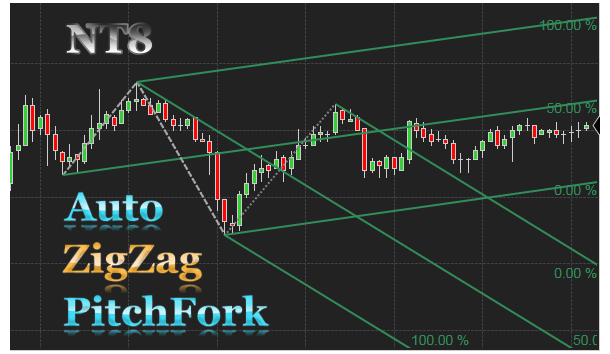
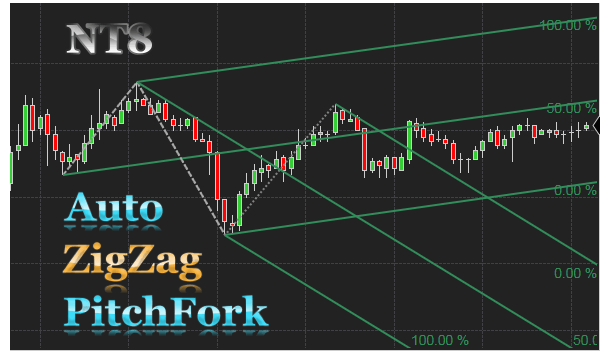
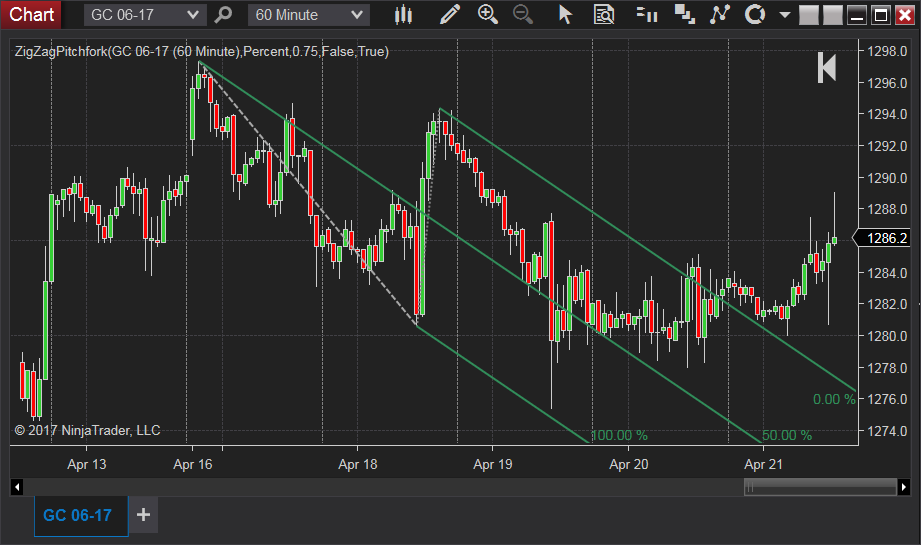
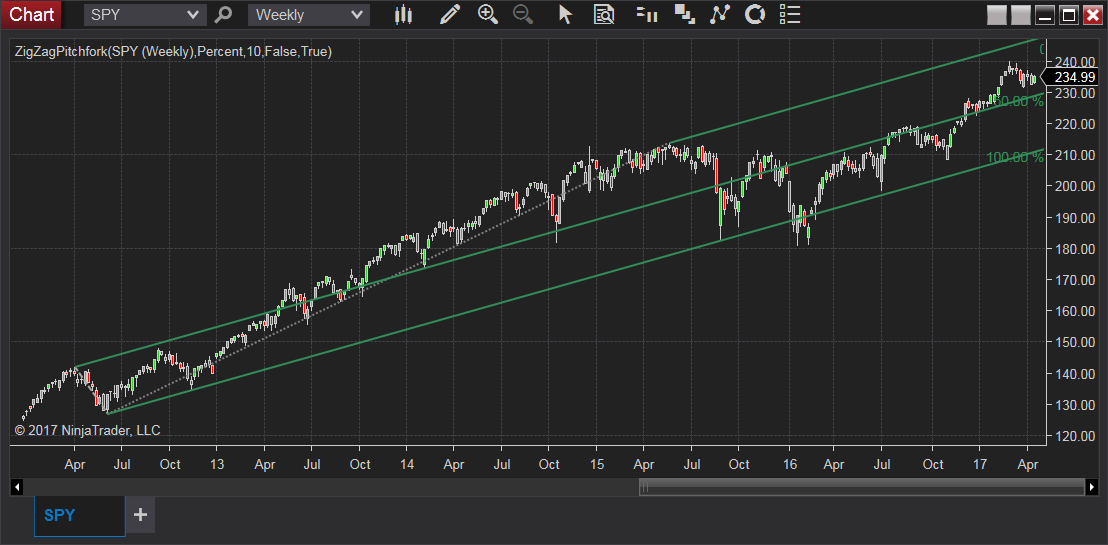
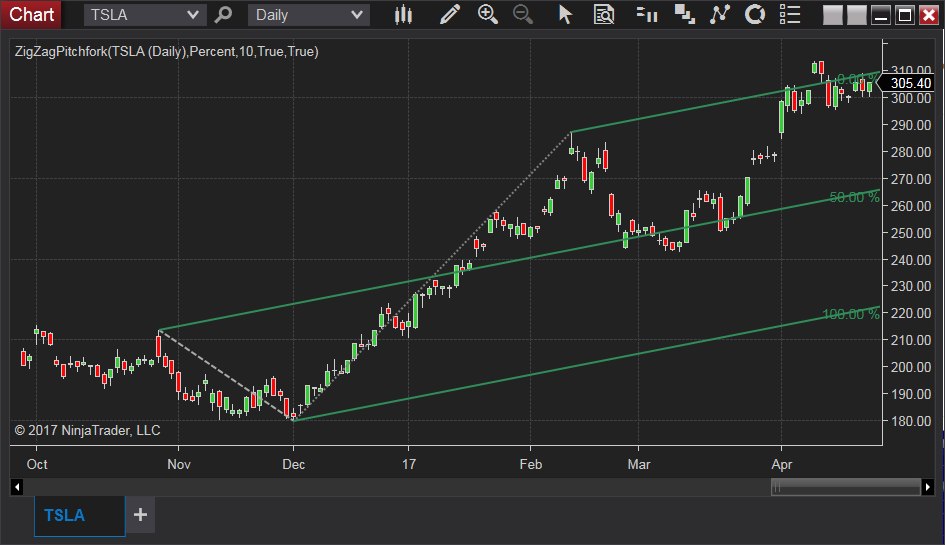
The Auto ZigZag Pitchfork creates a trend channel out of the 3 ZigZag high low price anchor points by connecting the first 2 points to form the anchor, and the next 2 points to form the retracement handle. From the first point then a trend line is drawn through the 50% midpoint of the retracement handle, parallel lines start from the other 2 points forming the channel.
You will be able to choose from three different Pitchfork Calculation Methods: ModifiedSchiff, Schiff, StandardPitchfork.
The Standard Pitchfork creates a trend channel out of the 3 user defined extreme price anchor points by connecting the first 2 points to form the anchor, and the next 2 points to form the retracement handle. From the first point then a trend line is drawn through the 50% midpoint of the retracement handle, parallel lines originating at the other 2 points forming the channel, while multiple further price levels could be set to allow for finer analysis.
In contrast, the Schiff Pitchfork variant is constructed then by shifting the first anchor of the Standard Pitchfork one-half the vertical distance between the first 2 anchor points.
As further alternation, the Modified Schiff Pitchfork variant is found by moving the first anchor to the midpoint of the original pitchfork's anchor handle, the trend-line connecting our first 2 anchor points.
It works on any timeframe and chart type that supports ZigZag, such as Renko, Heiken Ashi, Range and Tick. It uses the built-in version of Zigzag from NT8, but it doesn't plot the ZigZag line.
There are two Zigzag deviation type: percentage and point. The parameter "deviation value" is the actual number used for deviation type.
When you use percentage as the deviation type, it means that the value difference between two adjacent Zigzag point must be greater than the input percentage which is the deviation value.
For example, if you used percentage deviation type and set the deviation value to 0.1, then the value difference between each Zigzag point must greater than 0.1%. It also applies to all adjacent Zigzag points.
When you use point as the deviation type, it means that the value difference between two adjacent Zigzag point must be greater than the input point which is the deviation value. The value of Point is the actual price amount, if you set deviation value to 1, the value difference between each Zigzag point must greater than $1. It also applies to all adjacent Zigzag points.
For example, if you used a percentage deviation type and set the deviation value to 0.1, the value difference between two adjacent Zigzag points must greater than $0.1.
If "Use Recent ZigZag" is enabled, the indicator will use the most recent stable ZigZag, otherwise it will use the previous one. Please check the video below for a better understanding of how ZigZag Pitchfork plots on different inputs.
The Pitchfork indicator has the same functionality as the manual drawing Pitchfork.
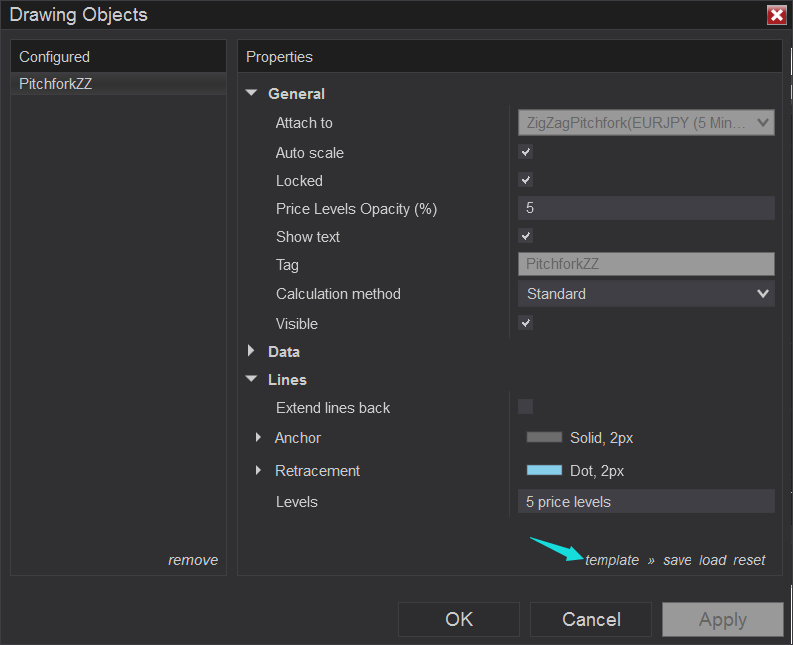
You can customize the pitchfork by double-clicking on it, it is the same as how you change any of your manual drawing object.
After you're double-clicking on the Pitchfork, you will see a window as shown below.
If you previously saved any template for your hand drawing Pitchfork, you can also use it for this indicator, it will save you a lot of time.
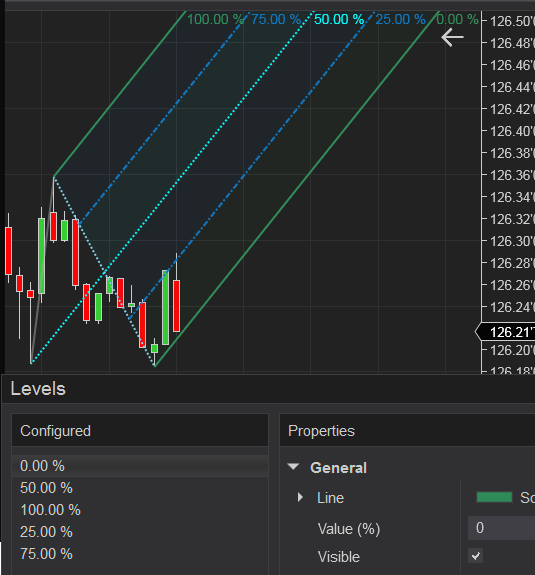
The picture below is an example of adding to two more levels to the pitchfork indicator with different line style and color.
By adding two or more of the ZigZag Pitchfork indicator, we can observe the support and resistance levels from different angles.
After the price broke the resistance level of a downtrend, a new uptrend will be formed just like the chart shown in below.

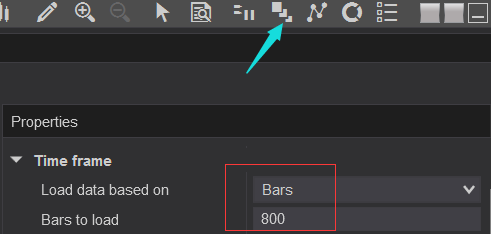
The indicator may not work properly if there was not enough bars on the chart.
In general, 800 bars is good, but it also depends on the ZigZag Deviation value you set.
The bigger the Deviation value is, the more bars you need to load.
You can change "bars to load" by following the pic below.




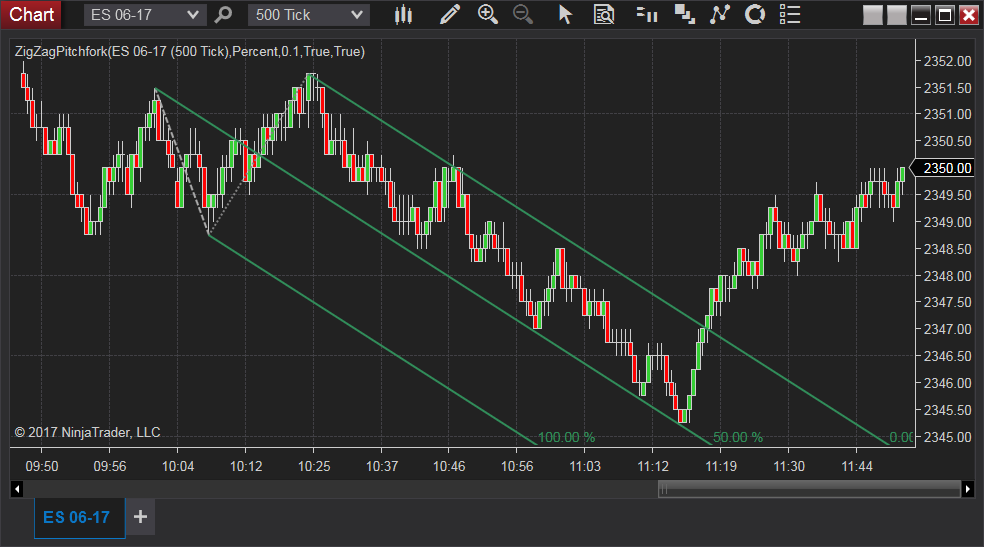
The Auto ZigZag Pitchfork (often referred to as an "Andrews' Pitchfork" or "Median Line" tool) is an advanced and highly respected tool among technical analysts. Its usefulness lies in its ability to objectively define a trend's trajectory and predict future support and resistance levels with a remarkable degree of accuracy.
The "Auto ZigZag" part of its name is key—it means the indicator automatically identifies the most significant highs and lows (swing points) to draw the Pitchfork, removing human subjectivity and saving a tremendous amount of time.
This tool also projects Fibonacci levels within the Pitchfork's structure, making it even more powerful.
Here's a detailed breakdown of why it's so valuable for trading.
1. It Objectively Defines the Trend's "Median Path" and Channel
The core of the Pitchfork is the Median Line, which acts as a dynamic midline of the trend.
-
What it does: The tool is drawn using three points (P0, P1, P2), typically a significant high/low and two subsequent retracement highs/lows. The "Auto ZigZag" feature finds these points for you.
-
The Median Line is drawn from P1 to the midpoint between P0 and P2.
-
Two parallel lines are drawn from P0 and P2, creating a channel.
-
-
Why it's useful: This channel objectively defines the trend's expected path. In an uptrend, the Median Line and the upper parallel (ML +1) act as dynamic support. In a downtrend, they act as dynamic resistance. This provides a clear, visual structure for the market's movement.
2. It Provides Dynamic, Tiered Support and Resistance
The true power of the Pitchfork is in the multiple levels it provides.
-
What it does: The tool creates a hierarchy of levels:
-
Median Line (ML): The central, most important line.
-
Upper Parallel (ML +1) & Lower Parallel (ML -1): The outer boundaries of the main channel.
-
Warning Lines (ML +0.5, ML -0.5, etc.): Lines halfway between the Median Line and the parallels. These are often where price will stall before reaching the main channel boundary.
-
Fibonacci Extensions (100%, 50%): Many Auto project Fibonacci levels beyond the parallels.
-
-
Why it's useful: This creates a complete "roadmap" for price. You don't have just one support level; you have a series of them. This allows for precise entry, scaling into positions, and profit-taking.
3. It Generates High-Probability Trading Setups
The interaction between price and the Pitchfork lines creates classic, high-probability trade opportunities.
-
Reversion to the Mean (The Primary Strategy): Price has a strong tendency to return to the Median Line after deviating from it.
-
Long Entry: In an uptrend, buy when price pulls back to the Median Line or the lower parallel (ML -1) and shows signs of bouncing (e.g., a bullish hammer candlestick).
-
Short Entry: In a downtrend, short when price rallies back to the Median Line or the upper parallel (ML +1) and shows signs of rejecting (e.g., a bearish shooting star).
-
-
Momentum / Breakout Play: A strong trend is confirmed when price rides along one of the outer parallels. A break outside the channel can signal an acceleration of the trend, with the warning lines and Fibonacci extensions acting as profit targets.
4. It Signals Potential Trend Reversals
The Pitchfork is excellent for spotting when a trend is losing strength and may be reversing.
-
What it shows: If price consistently fails to reach the Median Line on a pullback or, conversely, breaks decisively through and closes outside the opposite side of the channel, it is a strong signal that the original trend is invalidated.
-
Why it's useful: This provides an objective exit signal for trend-following positions. For example, if you are long in an uptrend and price breaks below the lower parallel (ML -1), it's a clear sign to exit the trade.
Practical Trading Example (Uptrend)
-
Identification: The Auto ZigZag Pitchfork indicator automatically draws a Pitchfork on your chart. The Median Line is sloping upward.
-
Pullback: The price, which has been in an uptrend, begins to pull back.
-
Entry: The price declines and touches the Median Line. As it touches, a bullish hammer candlestick forms. You enter a long position.
-
Stop-Loss: You place your stop-loss order just below the Lower Parallel (ML -1).
-
Profit Target: Your initial profit target is a move back up to the Upper Parallel (ML +1). Your secondary target could be the 100% Fibonacci extension level beyond the Pitchfork.
Crucial Limitations and Tips for Use
-
Point Selection is Everything: The entire validity of the Pitchfork depends on the correct selection of the three initial points (P0, P1, P2). The "Auto ZigZag" feature is designed to solve this, but it's not perfect. Always ensure the automatically chosen points are the most logical and significant swing points.
-
It's a Guide, Not a Crystal Ball: The Pitchfork shows a probable path, not a certain one. Price will often overshoot or undershoot the lines.
-
Best in Trending Markets: Like most trend-following tools, it is most effective in clear, trending markets. It will give poor signals in choppy, sideways (ranging) markets.
-
Confluence is Key: A touch of the Median Line becomes a much stronger signal if it also aligns with:
-
A traditional horizontal support/resistance level.
-
A key Fibonacci retracement level (e.g., 61.8%).
-
A moving average (e.g., the 50-period EMA).
-
Summary: Why the Auto ZigZag Pitchfork is Useful
In essence, the Auto ZigZag Pitchfork is useful because it:
-
Automates Complex Analysis: Saves time and removes the subjectivity of manually finding swing points to draw a Pitchfork.
-
Maps the Trend's Structure: Provides a dynamic, objective channel that defines support, resistance, and the trend's median path.
-
Creates a Trading Plan: Offers clear levels for entries, stop-losses, and profit targets (enhanced by Fibonacci projections).
-
Warns of Trend Changes: Signals when a trend is weakening by showing a failure to reach key median lines or a break of the channel.
It is the ultimate tool for the trader who wants to move beyond simple horizontal lines and understand the market's inherent cyclical and channeled nature, all with the efficiency of automation.
Write a review
Your Name:Your Review: Note: HTML is not translated!
Rating: Bad Good
Enter the code in the box below:


Latest
Welcome to Patternsmart
Converting your indicator from one platform to another.Custom Alert, Autotrader, Indicators, Scan, Screener, Strategy and Signals.
Copyright @ 2026 Patternsmart - All rights reserved
This website is for educational and informational
purposes only and should not be considered a solicitation to buy or sell a
futures contract or make any other type of investment decision. It's not recommended to use any single indicator as sole evaluation criteria. The companies
and services listed on this website are not to be considered a recommendation
and it is the reader's responsibility to evaluate any product, service, or
company. patternsmart is not responsible for the accuracy or content of any
product, service or company linked to on this website.
Futures trading
contains substantial risk and is not for every investor.Please read the following risk disclosure before considering the
trading of this product:
Futures Risk Disclosure. An investor could
potentially lose all or more than the initial investment. Risk capital is money
that can be lost without jeopardizing ones financial security or life style.
Only risk capital should be used for trading and only those with sufficient risk
capital should consider trading. Past performance is not necessarily indicative
of future results.
Trading stocks, options, futures and forex involves
speculation, and the risk of loss can be substantial.Investor must consider all
relevant risk factors, including their own personal financial situation, before
trading. Trading foreign exchange on margin carries a high level of risk, as
well as its own unique risk factors. Forex investments are subject to
counter-party risk, as there is no central clearing organization for these
transactions. Please read the following risk disclosure before considering the
trading of this product:
Forex Risk Disclosure. Spreads, Straddles, and other multiple-leg option
strategies can entail substantial transaction costs, including multiple
commissions, which may impact any potential return. Options are not suitable for
all investors as the special risks inherent to options trading may expose
investors to potentially rapid and substantial losses. Prior to trading options,
you should carefully read
Characteristics and Risks of Standardized Options.
patternsmart.com
will not be held liable for the loss of money or any damage caused from relying
on the information on this site. Any investment decision you make in your account is solely your responsibility.
TESTIMONIAL DISCLOSURE: TESTIMONIALS APPEARING ON OUR SITE MAY NOT BE REPRESENTATIVE OF THE EXPERIENCE OF OTHER CLIENTS OR CUSTOMERS AND IS NOT A GUARANTEE OF FUTURE PERFORMANCE OR SUCCESS.